How much capital gains tax do you pay when you sell a house in Arizona?
Most homeowners who've lived in their house for at least two of the last five years can exclude up to $250,000 of profit from federal capital gains tax if they're single, or up to $500,000 if married filing jointly — and Arizona taxes any remaining gain as ordinary income at the state level, not a separate capital gains rate. Whether you owe anything at all depends on your profit, your filing status, and how long you've owned the home. A tax professional should confirm your specific number, but here's the framework.
By Teresa Hague | October 2, 2026
If you've owned your Phoenix or Scottsdale home for several years, there's a good chance it's worth a lot more than you paid for it. That's great news — until you start wondering how much of that gain you actually get to keep.
This comes up constantly with longtime owners — especially those thinking through a strategic move later in life — who are weighing whether now is the right time to sell. (Link "thinking through a strategic move later in life" to: https://citiea.com/blog/thinking-about-selling-after-60-how-to-make-your-arizona-move-strategically) Here's the framework for understanding what you might owe, so you're not guessing.
The Federal Exclusion Most Sellers Qualify For
The IRS allows most homeowners to exclude a significant chunk of profit from capital gains tax under what's commonly called the Section 121 home sale exclusion.
To qualify, you generally need to have:
- Owned the home for at least two of the last five years
- Lived in it as your primary residence for at least two of the last five years (the two years don't have to be continuous)
- Not used this exclusion on another home sale in the last two years
If you qualify:
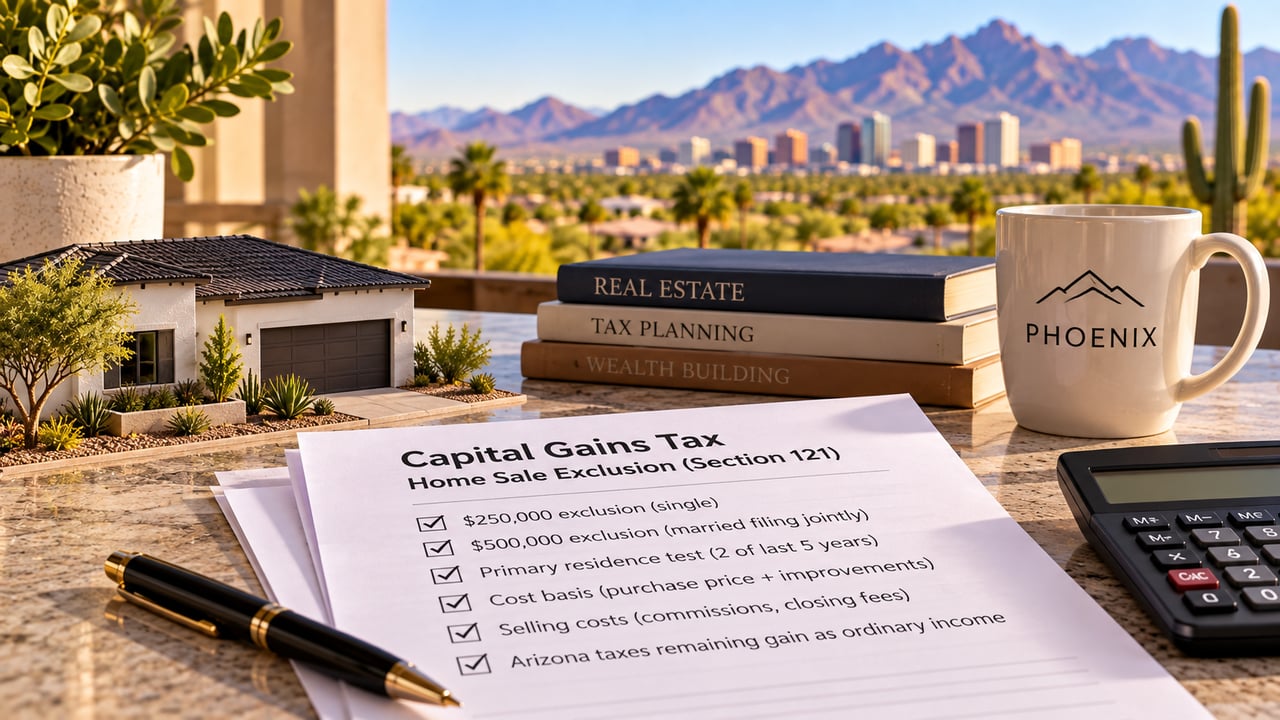
- Single filers can exclude up to $250,000 of profit
- Married couples filing jointly can exclude up to $500,000 of profit
"Profit" here means your sale price minus your cost basis — generally what you paid for the home, plus the cost of qualifying improvements over the years, minus selling costs like agent commissions and closing fees. It's not simply sale price minus purchase price.
For a lot of Phoenix-area sellers who bought years ago and have watched their equity grow, this exclusion covers the entire gain, and no federal capital gains tax is owed at all.
When You Might Actually Owe Something
A few situations change the math:
Your gain exceeds the exclusion. If you're single and your profit is $300,000, the first $250,000 is excluded and the remaining $50,000 is taxable. Married couples run the same math against the $500,000 threshold.
It wasn't your primary residence. A rental property, an inherited home you never moved into, or a second home in Arizona doesn't get the same exclusion — different rules apply, and the tax exposure is usually higher.
You haven't lived there long enough. If you're selling before hitting the two-year mark, you may not qualify for the full exclusion, though some exceptions exist for job changes, health reasons, and other qualifying circumstances.
Depreciation recapture, if you ever rented it out. If you claimed depreciation on the property during any period it was a rental, that portion gets taxed separately when you sell, regardless of the exclusion.
How Arizona Taxes the Rest
Arizona doesn't have a separate capital gains tax rate the way some states do. Instead, any taxable gain left over after your federal exclusion gets added to your other income and taxed as ordinary income on your Arizona state return.
There has also been legislative discussion in Arizona around changing how home-sale gains are taxed at the state level — this is still moving through the process, so it's worth checking with your CPA on where things currently stand before you assume any particular outcome.
What This Means If You're Deciding Whether to Sell
For most everyday Phoenix and Scottsdale sellers in the low end up to $1M range, the federal exclusion covers most or all of the gain, and taxes end up being a smaller factor in the decision than people expect going in. But "most" isn't "all," and the two-year residency requirement, your filing status, and whether the home was ever a rental can all change your number significantly.
Before you decide to hold onto a home longer than you want to, or rush a sale for tax reasons, it's worth running your actual numbers rather than assuming. Every situation is different, and the only way to know your real exposure is to look at your specific purchase price, improvements, and timeline with someone who can walk through it with you — alongside the other costs that come out at closing, like what you'll actually pay in closing costs. (Link "what you'll actually pay in closing costs" to: https://citiea.com/blog/arizona-closing-costs-explained)
This is exactly the kind of question we help sellers work through before they list — understanding your full net proceeds, taxes included, so you know exactly what you're walking away with. If getting the most money out of your sale matters to you, ask us about the 72SOLD program; it's helped Phoenix-area sellers net 6.3% more on average and sell 41% faster than the MLS average.
Frequently Asked Questions
Do I have to pay capital gains tax if I sell my house in Arizona?
Not necessarily. If you've owned and lived in the home as your primary residence for at least two of the last five years, you can likely exclude up to $250,000 ($500,000 if married filing jointly) of profit from federal tax, and many sellers' entire gain falls under that threshold.
How is my capital gain calculated when I sell my home?
Your gain is generally your sale price minus your cost basis (what you paid, plus qualifying improvements) minus selling costs like commissions and closing fees — not simply the difference between your purchase price and sale price.
Does Arizona have its own capital gains tax rate?
No. Arizona taxes capital gains as ordinary income at the state level rather than applying a separate capital gains rate, so any gain not excluded federally gets added to your other income on your state return.
What if I haven't lived in the house for two full years?
You may not qualify for the full exclusion, though exceptions exist for certain situations like a job change, health issue, or other unforeseen circumstances. A tax professional can confirm whether your situation qualifies for a partial exclusion.
Does this exclusion apply to a rental property or second home?
No — the primary residence exclusion applies to the home you've actually lived in as your main residence. Rental properties and second homes are taxed differently, often including depreciation recapture if you ever claimed it.
About Teresa Hague
Sell the easy way. Teresa Hague and the CITIEA team help Greater Phoenix homeowners sell their homes for 6.3% more money on average and 41% faster than the MLS average, backed by almost a billion dollars in annual home sales across the Phoenix metro market. Better marketing, more exposure, stronger results — see why Greater Phoenix homeowners choose CITIEA to sell faster and for thousands more.