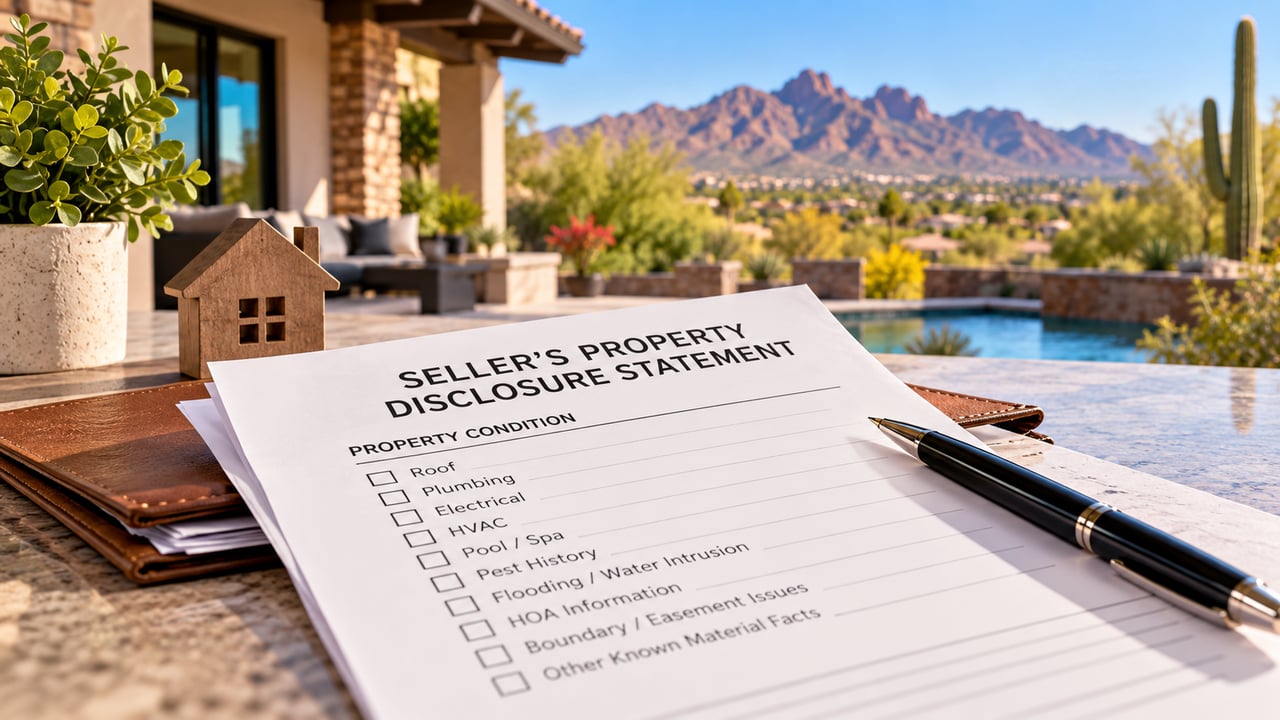
What do sellers have to disclose when selling a house in Arizona?
Arizona sellers are required to complete a Seller's Property Disclosure Statement (SPDS) that details known material facts about the property's condition — things like past flooding, roof leaks, plumbing or electrical issues, pest problems, and HOA violations. Arizona law requires sellers to disclose known material defects, and the SPDS is the standard form used to do it. Leaving something off that you knew about can expose you to a lawsuit well after closing, which is why getting it right matters more than people expect going in.
By Teresa Hague | October 2, 2026
Nobody loves filling out the Seller's Property Disclosure Statement. It asks a long list of specific questions about your home's history, and it's tempting to rush through it or leave something off that seems minor.
Here's why that's a mistake, and exactly what you need to get right.
What the SPDS Actually Covers
The SPDS walks through your home system by system and asks what you know. That typically includes:
- Structural issues — foundation problems, settling, past repairs
- Roof condition — age, leaks, past repairs or replacement
- Plumbing and electrical systems — known issues, outdated components, past repairs
- HVAC — age, known problems, recent service
- Water intrusion or flooding — anywhere on the property, even if it was years ago and resolved
- Pest history — termites, past infestations, treatments
- Pool and spa equipment, if applicable
- HOA information — violations, disputes, special assessments, pending litigation
- Known boundary or easement issues
The key word throughout is "known." You're not required to hire inspectors to discover problems you don't know about, and you're not liable for defects you genuinely had no way of knowing existed. But if you know about something and leave it off, that's a different story.
Why Getting This Wrong Is a Bigger Risk Than People Think
Arizona law requires sellers to disclose known material facts about a property, and buyers rely on your disclosure statement when they decide to move forward with the purchase. If a buyer later discovers you knew about a problem — say, a roof leak you patched yourself and never mentioned, or a plumbing issue you fixed once and assumed was resolved — and didn't disclose it, you can be held liable well after closing.
This isn't a theoretical risk. Failure-to-disclose claims are one of the more common sources of post-closing disputes in Arizona real estate, and they can surface months or even years after you've moved on, long after the transaction feels finished.
The standard here isn't perfection — it's honesty about what you actually know. If you're not sure whether something counts as "material," the safer move is almost always to disclose it and let the buyer, their inspector, or their agent decide whether it matters to them.
What If You're Not Sure Something Is a "Known" Issue?
A few situations come up constantly:
You fixed something years ago and it's never recurred. Disclose it anyway, along with when and how it was repaired. "I had a slab leak in 2021, it was repaired by a licensed plumber, and I haven't had an issue since" protects you far more than silence does.
You inherited the home or never lived in it full-time. You can only disclose what you actually know. Be upfront on the form about your limited firsthand knowledge of the property's history rather than guessing or leaving sections blank.
A tenant mentioned an issue you never personally verified. If you heard about something, even secondhand, it's safer to note it than to pretend you never heard it.
You're genuinely unsure if something matters. When in doubt, disclose. An over-disclosed form has never cost a seller a lawsuit. An under-disclosed one has.
How This Connects to Pricing and Timing Your Sale
A thorough, honest SPDS does more than protect you legally — it also helps set realistic expectations before you ever get to the negotiating table. (Link "helps set realistic expectations before you ever get to the negotiating table" to: https://citiea.com/blog/what-should-i-fix-or-update-before-i-list-my-home-in-phoenix-or-scottsdale) Buyers who see a detailed, honest disclosure upfront tend to negotiate less aggressively during the inspection period than ones who feel like they're uncovering surprises as they go. (Link "the inspection period" to: https://citiea.com/blog/property-inspections-in-phoenix-az-what-luxury-buyers-must-know-before-closing)
If you're getting ready to list and want a second set of eyes on your disclosure before it becomes a legal document attached to your sale, that's exactly the kind of thing we walk every seller through before we ever put a home on the market. Reach out before you fill it out — a 20-minute conversation up front can save you a much longer one after closing.
Frequently Asked Questions
Do I have to fill out a Seller's Property Disclosure Statement in Arizona?
It's not technically required by statute in every transaction, but it's standard practice in nearly every Arizona residential sale and strongly expected by buyers, their agents, and title companies. Skipping it or filling it out carelessly significantly increases your legal exposure.
What happens if I don't disclose something I knew about?
A buyer who discovers an undisclosed known defect after closing can potentially sue for damages, including repair costs and sometimes more. These claims can surface long after the transaction closes, which is part of what makes them so costly to deal with.
Do I need to disclose a problem I already fixed?
Yes. Disclose the issue along with the repair — when it happened, who did the work, and whether it's recurred. This protects you more than omitting it, even though the problem is resolved.
What if I don't know the full history of the house?
You're only required to disclose what you actually know. If you inherited the property, bought it without living in it, or have limited history, say so clearly on the form rather than guessing or leaving it blank.
Can a home inspection replace the need for an honest disclosure?
No. A buyer's inspection and your disclosure statement serve different purposes — your disclosure reflects what you know as the owner, while an inspection reflects what a third party can observe at a single point in time. Buyers and their agents expect both, and a mismatch between the two is exactly what triggers disputes.
About Teresa Hague
Sell the easy way. Teresa Hague and the CITIEA team help Greater Phoenix homeowners sell their homes for 6.3% more money on average and 41% faster than the MLS average, backed by almost a billion dollars in annual home sales across the Phoenix metro market. Better marketing, more exposure, stronger results — see why Greater Phoenix homeowners choose CITIEA to sell faster and for thousands more.